





When Didier Kassaï's exhibition at galerie gugging opened this past June, he wasn't in the room. He sent a letter instead, to be read aloud at the vernissage. In it, he called the exhibition “one of the most significant appearances of his career outside the Central African Republic”, a country, he wrote, with no proper gallery of its own, where artists have little way to show their work beyond the occasional visitor buying a souvenir. It was a modest way to describe what is, in fact, a milestone: the first time Didier Kassaï's work has been exhibited in Austria, and one of the very few times it has been exhibited in Europe at all outside comics festivals.
“COMICS brut”, the summer exhibition at galerie gugging, places Kassaï alongside Basel Al-Bazzaz, Manuel Griebler, and Hannes Lehner: four artists whose work, in different ways, tests the boundary between comics and Art Brut. It's a fitting pairing. Art Brut, a term coined by Jean Dubuffet to describe raw, unschooled artistic expression outside the academy, has been the gallery's focus for thirty years. Comics, with their autodidactic traditions and serial visual narration, share more with that lineage than a casual viewer might expect. As gallery director Nina Katschnig put it at the opening, "Comics are far more than entertainment; they open us to new perspectives and reveal truths."
Few artists make that case as directly as Didier Kassaï.
A Chronicler of Bangui
Kassaï was born in 1974 in Sibut, Central African Republic, into a family of artists: his mother, an illustrator, passed the practice down to him and his five brothers. He moved to Bangui at seventeen, supporting himself with manual labour while he found his way into illustration, and was discovered at a workshop run by the Centre Culturel Français in Bangui in 1990. He worked as an illustrator for several years before joining the newspaper Le Perroquet as a cartoonist in 1997, and went on to train across Africa and in Europe, including in Brussels.
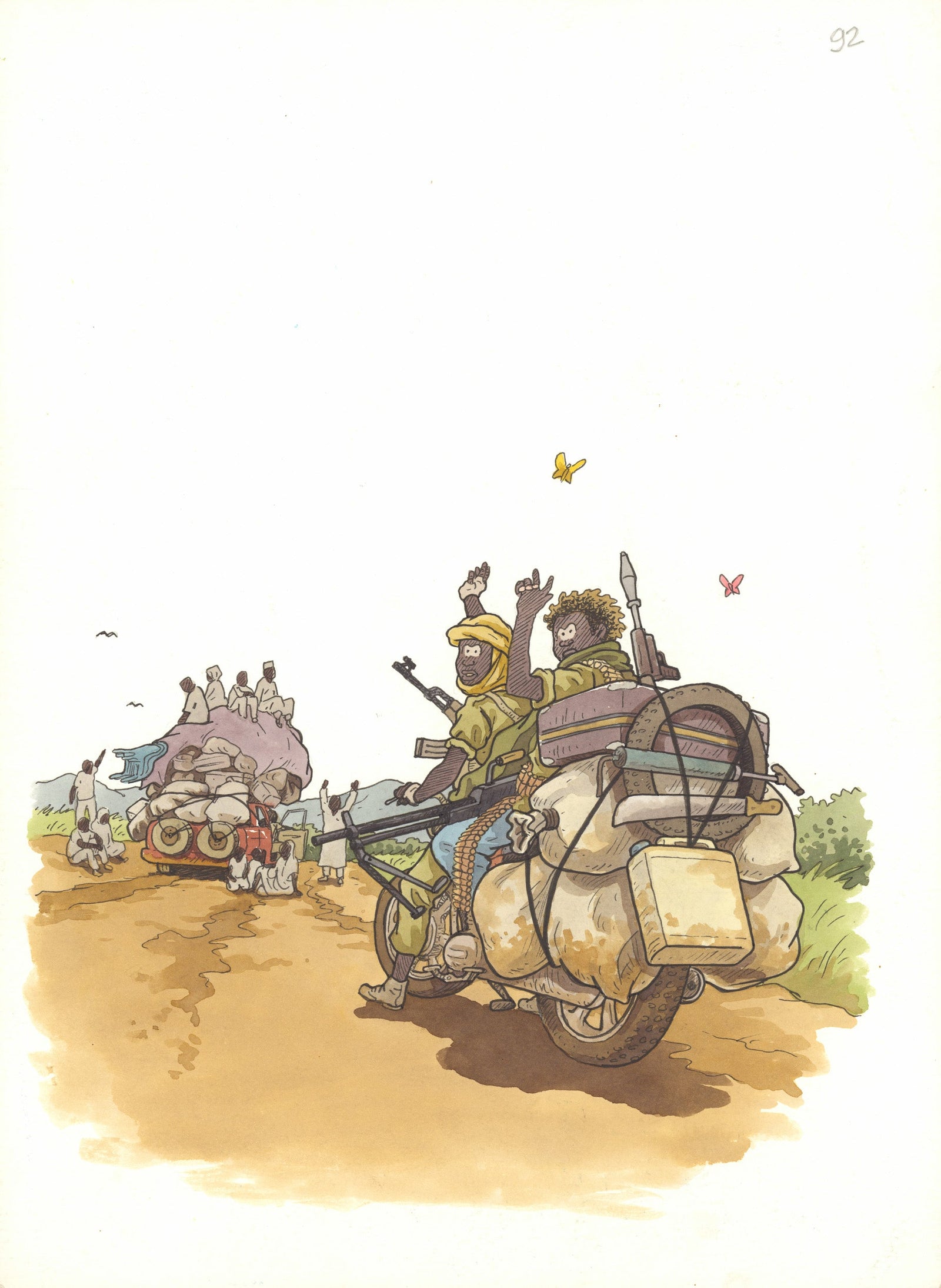
In the decades since, Kassaï has built a body of work that reads as both art and record. His graphic novel Tempête sur Bangui (Storm on Bangui), published in multiple volumes beginning in 2014, documents the 2013 Seleka coup and the anti-balaka violence that followed; Kassaï himself appears in it as a character, a witness inside his own testimony. He draws civilians and armed actors alike as faceless figures, marked only by eyes and mouths, a visual choice that flattens the usual hierarchy between victim and perpetrator, protagonist and crowd. He has said he uses humour deliberately, to make the weight of what he's depicting bearable. His other titles (L'Odyssée de Mongou, Pousse-pousse, Gipépé le pygmée) move between social commentary, education, and everyday life, and his work has been recognised internationally: the Prix Africa e Mediterraneo in 2006, the Pan-African prize at the Angoulême Festival, and the Prix du meilleur projet at Algiers in 2009, among others.
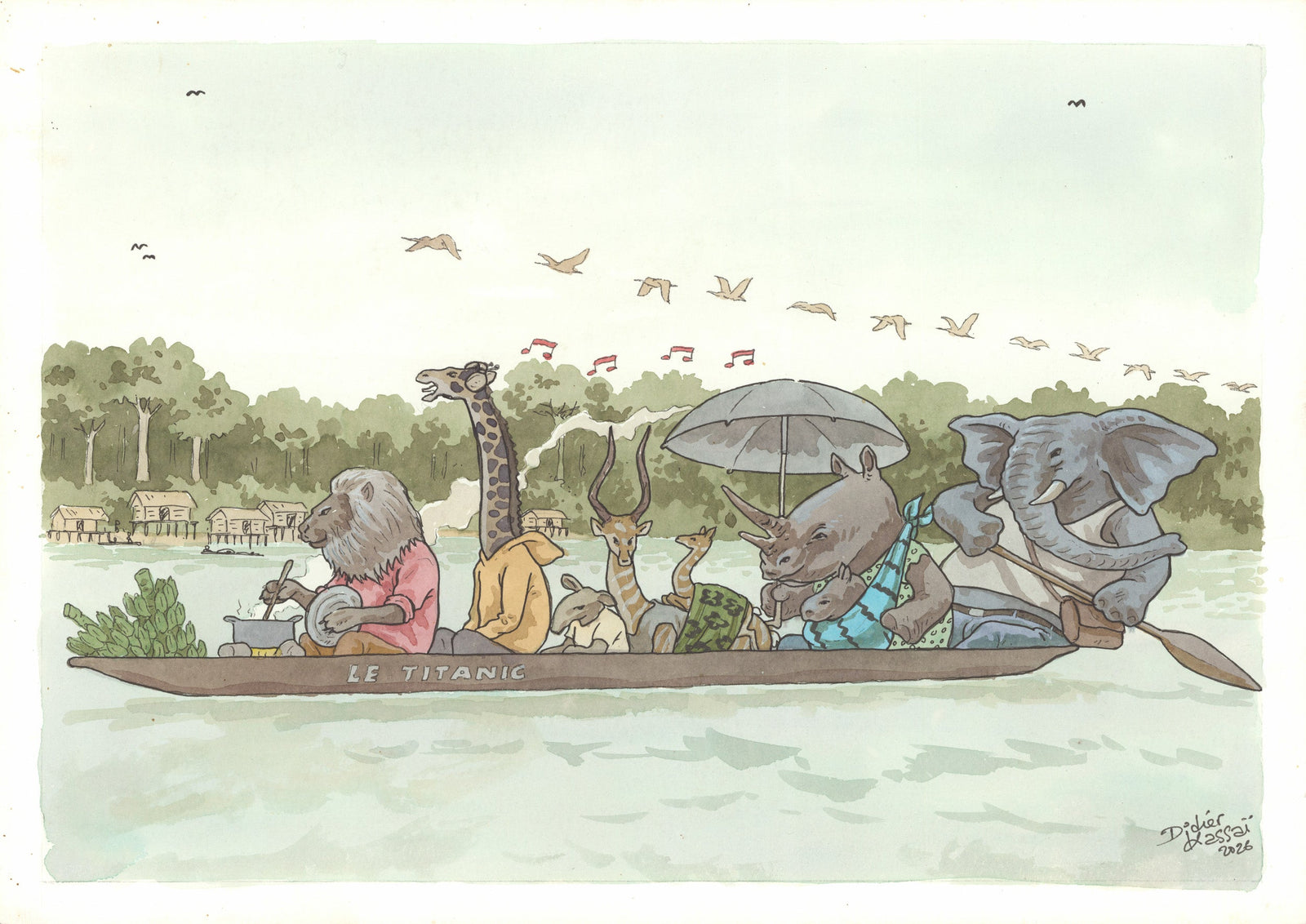
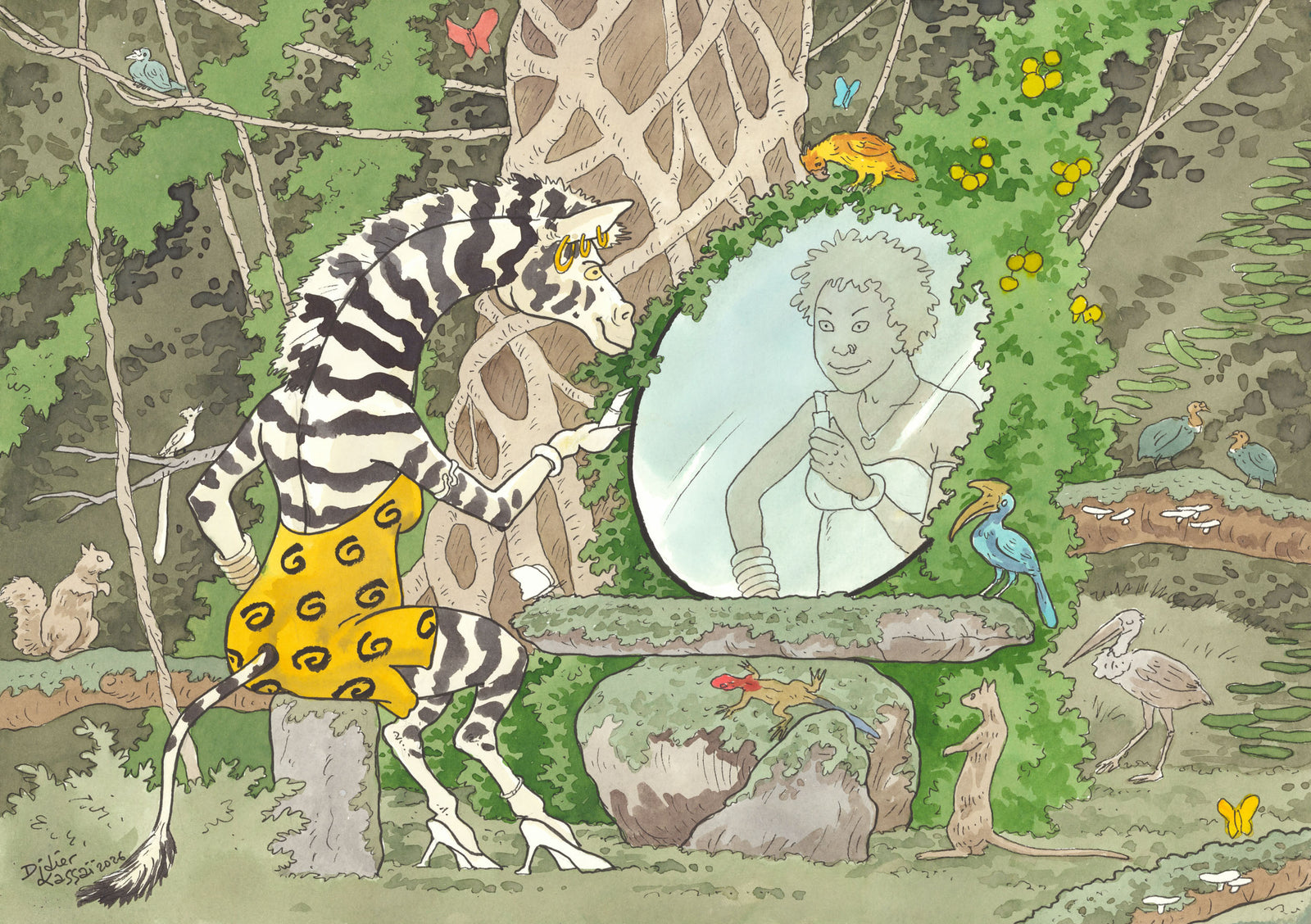
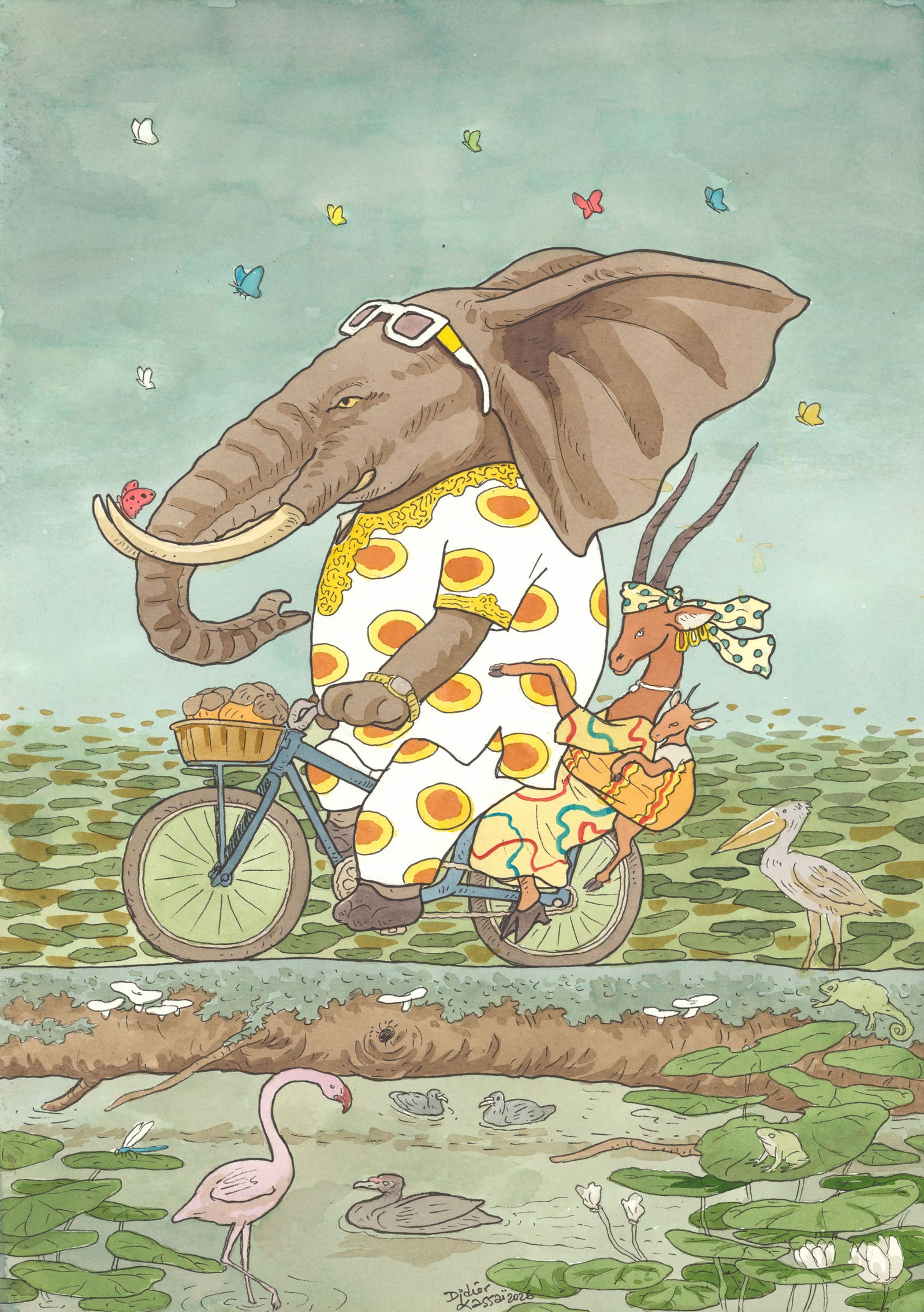
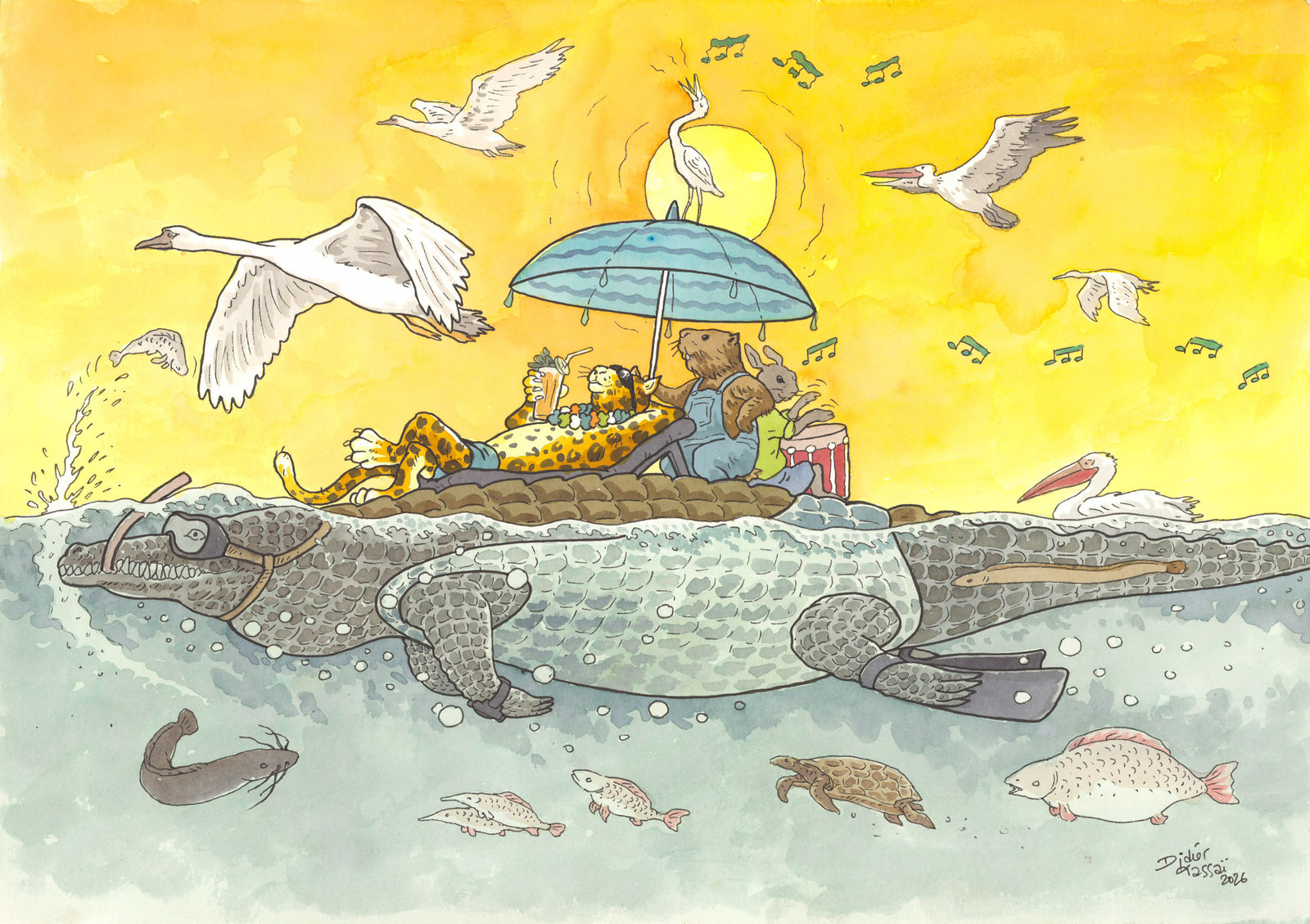
At galerie gugging, the works on view take a different visual form: clothed animal figures standing in for people, a device Kassaï uses to reflect the social realities of Central Africa. It's the same instinct at the centre of everything he draws: take what is happening around him, and find the visual language that lets someone else see it clearly.
Drawing Under Fire
None of this has come easily. The Central African Republic has spent much of the last decade in active conflict, with armed groups controlling large parts of the country and the state's authority thin outside Bangui. Kassaï's own home in the north of the city has been looted and burned more than once. He and his family have fled repeatedly. "Each time my family and I fled," he has said, "I took a little piece of paper and a pen with me." When his studio wasn't safe or reachable, he kept drawing from internet cafés.
The practical facts of working as an artist in Bangui are stark in a way that's easy to state and hard to fully register from outside: no gallery infrastructure in the country at all; unreliable electricity; art supplies that have to be sourced with difficulty and large expense; an adult literacy rate under 40 percent, which is part of why Kassaï has always seen visual storytelling as something closer to a public service than entertainment. He has worked on commission for Médecins Sans Frontières, Mercy Corps, and UN agencies, drawing comics on subjects from wound care to disarmament, because a comic can reach someone a pamphlet can't. As he's put it: comics "can transmit a message" in a way other forms can't, to people other forms don't reach.
Given all of that, Kassaï has had every reason to leave: to move somewhere with better infrastructure, steadier electricity, easier access to materials and markets. He has chosen, deliberately and repeatedly, not to. Part of the reason is a conviction that shows up again and again in how he talks about his work: that Central African stories have to be told by Central African artists. "For someone who is not Central African to tell our story," he has said, "it won't work."
A Teacher as Much as an Artist
That conviction is also why Kassaï spends as much energy training the next generation of Central African artists as he does on his own drawing. He has mentored younger cartoonists for years; his protégé Yvon Gandro, who met him at a workshop in 2008, is one of several artists now working in watercolour comics because Kassaï taught them how. What he teaches isn't just technique. It's a way of paying attention: how to observe a scene, a gesture, a piece of daily life, and narrate it back in a visual language that's genuinely one's own, rather than borrowed from outside. He is, in that sense, less interested in producing imitators than in producing other people who can see and narrate the way he does, in their own way, about their own lives.
This is the context that makes galerie gugging's involvement matter beyond a single artist's career. Kassaï isn't only a significant figure in Bangui's small, resource-starved art scene because of what he draws. He's significant because of who he's training, and because he has refused, under real pressure, to take his skills and his voice somewhere easier.
The Bridge to galerie gugging
Kassaï's route to galerie gugging began outside the art world entirely, with someone whose work in the Central African Republic had nothing to do with art, but who came across Kassaï's drawings, recognised what they were looking at, and made the connection that eventually reached Nina Katschnig and the gallery's team. It's a reminder of how much visibility for artists like Kassaï still depends on individual people choosing to pay attention and make a connection; there is no established pipeline moving Central African comics artists into European galleries. “COMICS brut” exists because a handful of specific people worked together to show it.
For galerie gugging, taking on Kassaï's work was also a natural extension of its own thirty-year project: making the case that self-taught, outside-the-academy art belongs at the centre of contemporary art discourse, not its margins. Kassaï's work fits that case precisely, and it does something more: it brings a living, urgent, specifically African set of stories into a European gallery built around a French idea of what "outsider" art could mean. “COMICS brut”, showing Kassaï next to Al-Bazzaz, Griebler, and Lehner, argues that the connections between comics and Art Brut aren't only formal. They're about who gets to narrate, and how.
What the Partnership Has Already Changed
Since “COMICS brut” opened in June 2026, the effect of that visibility has been concrete. Sales of Kassaï's work through the exhibition have already enabled him to put a roof on his art studio in Bangui: not a metaphor, an actual, physical improvement to the place where he works, in a city where that kind of investment is genuinely hard to make. It's a small detail with a large amount packed into it: a European gallery selling watercolour and comic art has translated, directly, into better working conditions for an artist several thousand kilometres away, in a country where electricity, materials, water, and safety are not guaranteed.
That's the part of this partnership that's easy to overlook if you're only looking at the walls of the gallery. Every purchase of a Kassaï piece is, at the same time, a transfer of resources into a specific set of practical necessities: the ability to buy paper and paint, to keep the lights on, to work through the next round of instability rather than being forced out of the practice altogether. It also does something less material but just as real: it gives Kassaï standing. A first exhibition in Austria and a growing international collector base carry their own kind of weight, one that extends to the people around him he's training to follow a similar path.
A Voice in Global Comics
It's worth being direct about what Kassaï represents, beyond the individual biography. Comics have a long tradition, worldwide, of functioning as reportage: a way to narrate political violence, environmental change, social upheaval, and the smaller texture of daily human interaction, in a form that reaches people other media doesn't. Kassaï's work sits squarely in that tradition, and he is one of very few artists bringing a Central African vantage point into it at all, let alone into a European gallery context. His comics on the 2013 coup and its aftermath are not illustrations of the news; they're a firsthand visual record, made by someone who lived through what he draws and kept drawing through repeated displacement.
Locally, in Bangui, that makes him something close to an institution: a working artist who has stayed, who trains others, and whose presence argues, just by continuing, that Central African art doesn't have to be made somewhere else to matter. Internationally, and now specifically through his connection to galerie gugging, it makes him a rare and valuable bridge, proof that Art Brut's core claim, that untrained, self-directed art belongs at the center of the conversation, not the margins, holds just as true when the art in question is documenting a war most of Europe has never closely followed.
Since the opening of “COMICS brut”, Didier Kassaï sent the gallery a new selection of work, now available alongside the pieces on view: a continuation of the same project he described in his letter for the vernissage, work made, as he put it, in times of peace and amid recurring conflict alike, because it's a labour of love he has chosen not to give up.